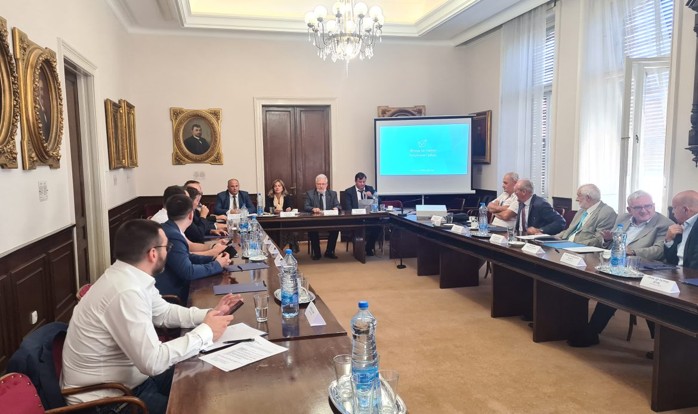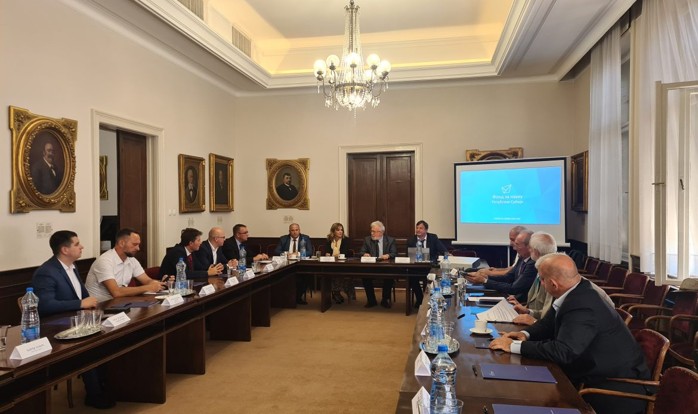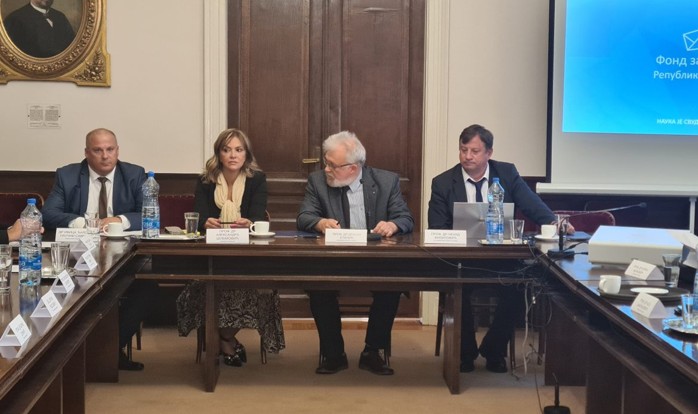


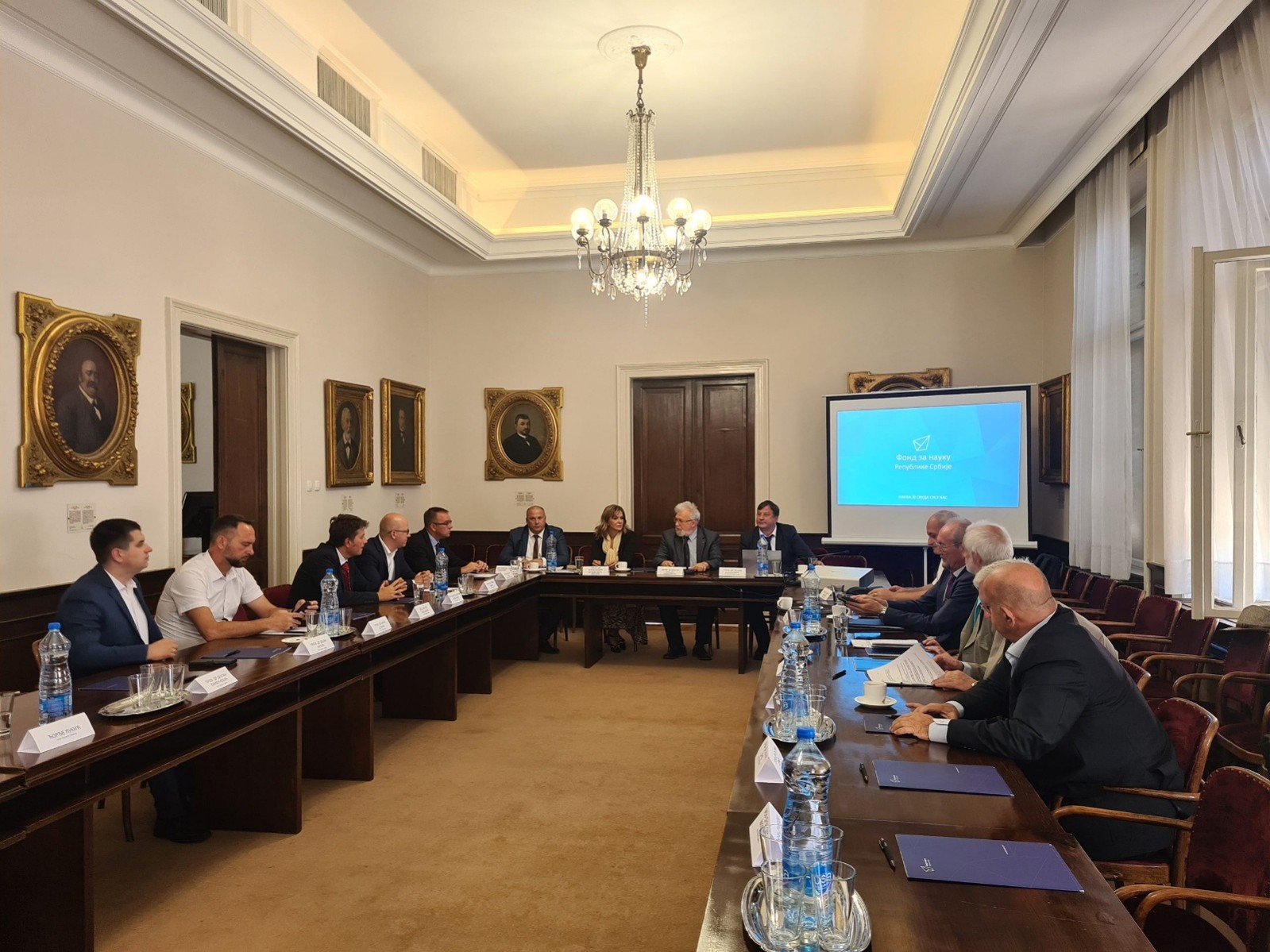
The second session of the Scientific Council of the Science Fund of the Republic of Serbia was held at the premises of Matica Srpska in Novi Sad. In addition to the members of the Scientific Council, the session was also attended by members of the Supervisory Board, as well as the State Secretary at the Ministry of Science, Technological Development and Innovation, Professor Aleksandra Šuvaković, PhD, and the Acting Director of the Science Fund, Professor Nenad Filipović, PhD.
In her opening remarks, State Secretary Professor Šuvaković welcomed the participants on behalf of the Minister of Science, Technological Development and Innovation, Academician Bela Balint. She expressed satisfaction with the holding of the joint session of the Scientific Council and the Supervisory Board, stating her belief that their work will yield positive results benefiting the entire scientific community. She added that the Ministry remains available to the Science Fund and will continue to provide support for future initiatives.
The Chair of the Scientific Council, Professor Dragan Stanić, PhD, emphasized that the Science Fund supports projects across a broad range of scientific disciplines, which is of great importance for the development of science in Serbia. He noted that there is room for greater support of projects in the social sciences and humanities and stated that he will personally advocate for stronger recognition of research in these fields within the Science Fund’s programs.
The Chair of the Supervisory Board, Dr Ivica Đalović, highlighted the significant role of the state in financing Science Fund programs, noting that 92% of the funding for the IDEAS 2024 program is provided from the budget of the Republic of Serbia. He also stressed the need to place greater emphasis on the commercialization of research results and to encourage an increase in the number of patents generated through funded projects.
The Acting Director of the Science Fund, Professor Nenad Filipović, PhD, presented an overview of the Fund’s work to date, including program activities, implemented programs, public calls, inter-institutional cooperation, and achieved results.
The session included discussions on the future development directions of the Science Fund. Participants addressed general acts of the Fund and the procedures applied in program preparation, project evaluation, and implementation. It was concluded that greater attention should be given to ensuring a more balanced geographical distribution of funded projects and that future programs should support consortia of research organizations from different regions of Serbia. Discussions also covered the selection process for peer reviewers involved in project evaluation. It was concluded that domestic reviewers should be given priority in the social sciences and humanities, particularly in research related to identity studies.
Participants also discussed the development of a new Strategy for Scientific and Technological Development, which is expected to play an important role in the further advancement of science in the Republic of Serbia. The State Secretary noted that a working group is currently developing the new Strategy, which will introduce new forms of support for science across various dimensions and will include significant innovations, with greater recognition of the social sciences and humanities compared to previous policy documents. The Chair of the Scientific Council stated that the Council, within its competencies, will contribute to the development of the new Strategy.